Moral behaviour: self-other, considering-obeying
This research section of the moraleducation.info website examines the relation between what we do and why we do it. Reasoned judgement may be complicated by deeper seated drives.
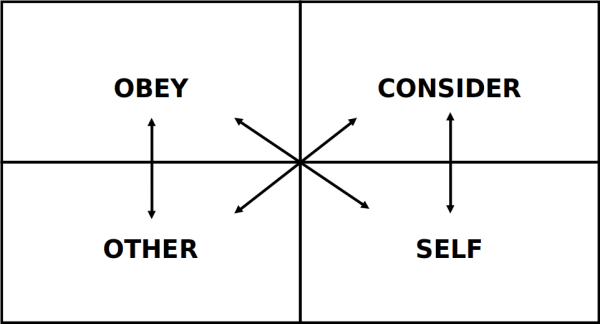
To illustrate, the four different patterns of behaviour are personified. Each of these represents commonly and cross-culturally found moral responses. All four may very well be found within the same individual, although usually with a personal hierarchy in implementation and a tendency for one to predominate. There's also a 'religious' variant.
CHARACTERS
|
MODE |
NAME |
CHARACTERISTICS |
|
External deference |
YESSER (Yes Sir!) |
Follows the lead and instructions given within such as family, school, peer group, neighbours, religion, state. |
|
Other considering |
PROTHERO (Pro-others) |
Takes the needs and interests of others as primary whether near or far. |
|
Internal authority |
GOTTO (Got to) |
Follows an internal sense of duty or obligation, sometimes associated with guilt, purity or shame. |
|
Self considering |
GIMME (Give me!) |
Reckons what will bring maximum personal advantage in both the short and long term. |
SIMPLE SCENARIOS
These are illustrated with reference to Mobile Phones. The four characters respond to issues regarding
- whether one can be afforded
- it ringing whilst you are watching a film in a public cinema
- sending a naked ‘selfie’
There are many different words for ‘mobile phone’ such as smartphone, mobile/mobi/mob; cellphone/celli/cell; pocket phone, handy, hp – but the issues are the same. Here are some initial examples of characteristic responses. Please send in additional ones to info@moraleducation.info.
Paying for a mobile phone?
| YESSER | “My Ma says they cost too much” “If you get one, you’ll only lose it/it’ll be stolen” “You’ll waste your time as well as my money” “It’s forbidden for me to take one into school” “Everyone else has one”. |
| PROTHERO | “It means this person can always reach me if they need to” “Every time I phone or text I put a penny in my giving box”. “Without it I’d be inaccessible to family/friends who might want to be in touch during the day”. |
| GOTTO | “However convenient a handy might be, I’d rather spend the money on actually meeting up” “I would feel bad if they couldn’t reach me” “Being connected is what humanity is properly all about”. |
| GIMME | “I don’t want to be left out” “It’s cool to text when I want” “I’d miss out on a lot that’s happening” “My parents bought it for me and pay the contract”. |
How to react regarding phone ringing during a public film show?
| YESSER | “Never, ever leave your cell switched on if you’re in an audience watching/listening!” “I read this warning about mobiles as we came in” “Some people never bother with rules” |
| PROTHERO | “I know that people get upset if a phone goes off on a public occasion so I always turn it off” “It’s such a distraction when this happens – for everyone else, and even the person whose phone it is”. |
| GOTTO | “I’d feel so embarrassed if it rang, I always leave it at home” “When it rang, I smothered it under my arm and with my coat and pretended it wasn’t mine”. |
| GIMME | “It’s no big deal. I can switch it off in a few seconds” “I’ll check who it is and then either answer or click off”. |
Should I send a photo of myself naked to someone I really like?
| YESSER | “No way, this would be against what I’ve been told about sex” “My friends are doing this all the time” “There’s no law against it”. |
| PROTHERO | This would be tempting someone to do something that would be wrong” “It might seem innocent fun but I’d be letting my parents down”. |
| GOTTO | “I’d feel dirty if he sent it on to others” “I’m proud of my body; shame doesn’t come into it” “It would just be wrong”. |
| GIMME | “I’m really hot for her and I think this would turn her on for me” “If I did this I’ve no control over who else sees it” “I’d like to be a model so this might be good to do for lots of reasons”. |
A 'religious' dimension. It is also possible to identify religious variants of each of these characters and characteristic ways of thinking and behaving:
| YESSER | The Priest, the Guru, the Imam says so. In accord with guidance from Church, Umma, Sangha, Party or obligations of Caste. This is what Bible/Gita /Qur’an/Adi Granth/Analects/Manfesto teaches. |
| PROTHERO | Love of neighbour; caring for poor, the sick, the stranger and lonely. Exemplified in the likes of Amos, Buddha, Freud, Jesus, Krishna, Mahavira, Marx, Muhammad. |
| GOTTO | ‘I can do no other’; It’s just wrong I know deep down’; gut feeling, mindful compassion, conscience, voice of God within, eternal Tao. |
| GIMME | Reputation. Prospects beyond death: qualification for heaven/hell, higher/lower being. Impact on family / inheritance. |
FOLLOW UP
A. ROLE PLAYING
You may like to try playing with each of the characters in turn. You might do this with the instance of the mobile phone and/or with others instances that you think of. Similarly, you might play with religious versions of each of the characters. Anyone can do this – on their own or in a group.
B. PERSONAL REFLECTION: WHERE DO YOU GET YOUR 'OUGHTS' FROM?
1. RELIGIOUS OTHER-OBEDIENCE. The ‘Divine Command’ theory of ethics is widely critiqued and dismissed by moral philosophers because of its ‘heteronomy’. At worst it is presented as blind compulsion and seen to apply wherever that authority is understood as extending to the Bible, or another Scripture; to the Priest, the Guru or the Imam; or to the Church, the Umma or other religious community; or an ultimate, transcendent source. It is no less open to question when it appears in functionally equivalent secular versions as Manifesto, Leader, or Party. This sort of ought risks surrendering its own capacity for moral discernment to a perceived and, though rationally questionable, superior authority. Less an internal ought, more an external instruction. However, that said, religious other-obedience may still be ‘owned’ because individually/consciously endorsed.
2. RELIGIOUS SELF-OBEDIENCE. Rather than being externally derived, this version of religious ought comes from within: “it’s just wrong I know deep down”, “my gut feeling tells me..”, “my conscience is shaming in advance or guilt-generating in retrospect”, “I can do no other”, “it’s the voice of God within”, “being at one with the eternal Tao.” Such sense of religious ought takes the form of internal compunction, rather than external obedience. It’s felt from within and therefore autonomous. A moral psychologist might agree, or they might say ‘it depends’. Is it perhaps only ‘the introjection of parental inhibition’, or even ‘a stubbornly indulgent and fear-animated over-sensitivity'?
3. RELIGIOUS SELF-CONSIDERATION/EGOCENTRICITY.
Traditionally this is perhaps most powerfully evident in the form of the post-mortem/after death carrot and stick. For instance, the ought in a person’s self-image and behaviour may be influenced by uncertainty/anxiety regarding what’s beyond death. Even if my wrong-doing isn’t picked up during my life-time, “I can’t get away with it.” Its consequences might be hellish rather than paradisal. They might lead to karmic regression rather than enhancement. They might have compounding family consequences - “The Lord...visits the iniquity of the fathers on the children and the children’s children, to the third and the fourth generation.” In other words, this religious ought is backed by a strong appeal to self-interest, and therefore might well be judged to be morally questionable. It’s rather like receipt of presents from Santa Claus being used to incentivise children’s good behaviour.
4. RELIGIOUS OTHER-CONSIDERATION/ALTRUISM.
It’s no less likely for religious ought to inspire autonomous concern for others – love of neighbour, care for poor/sick/stranger. Such behaviour is exemplified and promoted in the lives and teachings of Prophets and mentors. Its responsive care doesn’t depend on legal obligation or professional duty. It takes stock, it recognises need, and it acts accordingly. It discriminates positively. Here, the moral philosopher will approve of the priority being given to ‘empathy’, but may point to the risk of over-identification resulting in a potentially fatal carelessness for self. That same philosopher may also check for the extent to which the caring consideration is universally applied. How consistently or absolutely does it apply irrespective of race or nationality, of gender, age, or species as ‘all living creatures’?
C. IN CHECKING ANY CORRELATION OF RELIGION AND ETHICS, 'RE' AND 'ME', HOW ARE ‘RELIGION’ AND ‘GOD’ BEST DEFINED?
Is the former an umbrella term for a distinctive institutional tradition of human belonging? Or does it more comprehensively refer to a person’s deepest beliefs? Or both? Is the latter principally named in scriptural terms and/or the wondrous root of all being?